
Watching your baby grow and change during their first year is an amazing experience. Every day brings a new smile, a new sound, or a new milestone. Understanding what to expect can help you feel more confident and connected to your little one’s journey. This guide will walk you through the key stages of baby development & baby signing, offering insights into their first year of growth and how you can use simple signs to boost communication.
Your Baby’s First Year of Growth
From those first cuddles at birth to standing tall at 1 year, here’s a quick look at how babies grow on average during their first 12 months.
(0–1 month)
At birth, babies weigh about 3–4 kg but may lose some weight before regaining it. Their movements are mostly reflexes, like startling, sucking, and grasping. They begin focusing on faces and react to sounds.
(2 months)
Babies start to smile socially and can briefly hold their heads up during tummy time. This is also the stage when they start to coo.
(3 months)
By this age, they can hold their head a little steadier, follow objects with their eyes, and enjoy playtime with you.
(4 months)
Your baby might start babbling and can roll from their tummy to their back. They are also able to hold their head up without support.
(5 months)
They are now rolling both ways, reaching for and grabbing objects, and recognising familiar people and faces.
(6 months)
Your baby can sit with a little support, begins to eat solid foods in many cases, and responds to their name.
(7 months)
They can sit without support, pass objects from one hand to the other, and may begin to crawl or scoot around.
(8 months)
Crawling skills improve, and some babies can pull themselves up to a standing position. They also begin to understand the meaning of “no”.
(9 months)
At this stage, babies crawl well and might start “cruising” by walking while holding onto furniture. The pincer grasp, using the thumb and forefinger to pick things up, also begins. They may say “mama” or “dada” without necessarily knowing the meaning.
(10 months)
Babies will continue to pull themselves to a stand and cruise along furniture. They also start to wave and clap their hands and have more advanced babbling.
(11 months)
Many babies can stand without support for a brief period and might even take their first steps. They are also trying to imitate words and actions they see and hear.
(12 months/1 year)
By one year, many babies walk with or without help. They usually say one to three words with meaning and love interactive games like peekaboo. On average, a baby’s weight is about three times their birth weight, and their height is about 1.5 times their birth length.
Introducing Baby Signing
While these milestones are incredible, they don’t always align with your baby’s ability to speak. A baby’s desire to communicate often comes before they can form words, which can lead to frustration for both of you. This is where baby signing comes in.
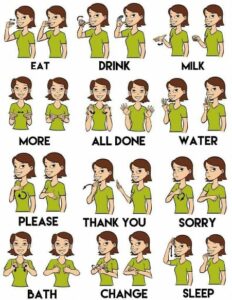
Baby signing is not the same as learning Auslan (Australian Sign Language). It involves using simple, easy-to-learn signs for everyday words like “milk,” “more,” or “all done” to help your baby communicate their needs and wants before they can talk.
The benefits of baby signing are significant. It can reduce tantrums and frustration because your baby can express themselves clearly. It also gives you a deeper understanding of your baby’s thoughts and needs, which strengthens your bond. In addition, using signs can support and even accelerate language development, as the signs are often used alongside spoken words.
How to get started with baby signing:
- Start simple: Begin with just one or two signs for things you use often, such as “eat” or “drink.”
- Say the word as you sign it: Always say the word while you make the sign. This links the sign to the spoken word and helps with language development.
- Be consistent: Use the sign consistently and encourage your family and caregivers to do the same.
- Have patience: It may take time for your baby to start signing back. Just keep using the signs and be patient. They are watching and learning from you.
The journey of watching your baby grow and develop is full of surprises and new discoveries. By understanding their developmental milestones and exploring tools like baby signing, you can better support their growth and enjoy this incredible time.
Explore our blog to get more expert advice.
Ready to Learn More?
The journey through parenthood is filled with questions and new experiences. For more personalised support and guidance on baby development, feeding, and connecting with your little one, our classes are designed to give you the confidence you need. You can book a class with Carmel to get more personalised support. You can also contact Carmel directly with any questions at [email protected].